Mid-Year 2026 Boston Office Report

The Greater Boston office market has continued to stabilize throughout the first half of 2026.
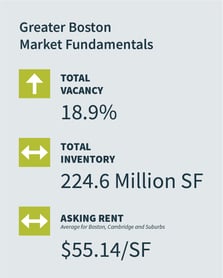 While the overarching theme still points to constrained fundamental, bright spots of momentum continue to emerge.
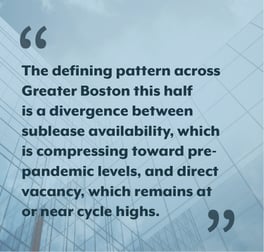
The defining pattern across Greater Boston this half is a divergence between sublease availability, which is compressing toward pre-pandemic levels, and direct vacancy, which remains at or near cycle highs in several submarkets. Back Bay has recorded its lowest Class B/C vacancy since Q1 of 2022, and sublease availability in this submarket is at levels not seen since 2019. A similar trend is unfolding in the Financial District, where sublease availabilities are at their lowest since the first half of 2020. Fundamentals have been further aided by the removal of 245 Summer Street – Fidelity’s headquarters – from the sublease market. However, weakness is still present in Boston’s largest office submarket. Despite several significant lease executions at South Station Tower, International Place, and Winthrop Center, direct vacancy remains near its highest point. The Seaport is mirroring the Financial District – sublease availability at near record lows, and direct vacancy at record highs.
The office market in Cambridge is decidedly quiet. Total vacancy has essentially plateaued at 20% city wide, with East Cambridge bearing the brunt of the vacancy – 21.5% as of the issuance of this report. Unlike Boston and many suburban submarkets, sublease availability has remained particularly stubborn here, and is currently at 5.6%. At the risk of over-emphasizing the malaise of Boston’s neighbor to the north: we have yet to observe an office-only lease executed in 2026 greater than 35,000 SF. Asking rents, much like the sublease availability, have also remained mostly static. The most movement has occurred in the Class B/C space – where asking rents now hover in the $52/SF range (FSG). This may reflect an interesting microcosm of tenant demand and price sensitivity. Landlords of Class B space are finding success in lowering their rents to meet the market of tenants with smaller use requirements who want to be in Cambridge – whereas larger, Class A assets have concerns that lowering their rents will not result in executed leases, but in lowering the buildings perceived valuation.
 Suburban markets face obstacles similar to those of Boston proper: significant declines in sublease availability, coupled with high water marks for direct vacancy. The Route 128 Northwest market in particular is now at its highest since the early 2000’s – north of 2 million SF of direct vacancy. Route 128 West’s total vacancy presently sits at 17.5% - notching significant decreases in both sublet and direct vacancy from its 2025 highs, which neared 21% in totality. In 495 West, both sublet and direct vacancy have steadily ticked up to total 21.7%. This is a notable reversal: the submarket was battered during the pandemic, posted a modest recovery through 2023, and has deteriorated steadily since.
The office market no doubt remains challenged. While it has stabilized, signs of a true recovery in leasing activity and corresponding vacancies have yet to emerge. However, office assets continue to trade at more attractive pricing (31 Saint James in the Back Bay being the most recent) and RTO mandates continue to take effect, which will on balance improve the narrative and outlook for the coming quarters.

For more information please contact:
Mark Fallon, Director of Research & Strategy | mfallon@hunnemanre.com