Mid-Year 2026 Boston Industrial Report

The narrative surrounding metropolitan Boston's industrial and flex market remains relatively unchanged through the first half of 2026 - with some notable exceptions.
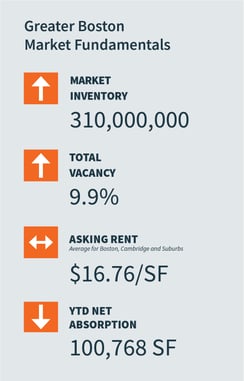
The 9.5% vacancy rate represents a relative high-water mark in the past ten years.
Total vacancy as of the issuance of this report is 9.9% – a nominal 30 basis point expansion from the close of 2025. Several large, speculative deliveries arrived in the first half of this year. Trident Logistics Center in Revere completed Phase I – 366,425 SF of high bay warehouse space, and buildings 1 and 3 on Maple Street in Stoughton, totaling 605,805 SF delivered as well. On the entitlements side, in April the Town of Hudson approved National Development’s plan to redevelop the former 148-acre Intel campus at 75 Reed Road into approximately 950,000 SF of industrial space. However, what is arguably more notable is the construction and delivery trend of small bay and/or shallow bay assets. Hunneman Research first observed this trend in 2023, as waves of large-block industrial assets flooded the greater Boston region – mostly unleased. There was a palpable pivot – demand for these enormous spaces had dried up, yet occupier interest in smaller product seemed insatiable. That construction boom that started in this space has now come to fruition, as over 40 buildings under 150,000 SF delivered across the Commonwealth in 2024, and an additional 10 have delivered so far this year alone. This draws an interesting contrast to the multifamily space where it is increasingly difficult to generate adequate returns on small developments. Thus, the majority of new construction is larger, ultra-amenitized, “luxury” developments. In this asset class, however, constraints are much different; smaller buildings have strong demand and can offer the revenue profile developers seek.
 Asking rents notched measurable gains throughout this year driven by two main factors: the climatetech renaissance currently underway throughout the Commonwealth, and assets immediately adjacent to airports. In previous years, urban warehouses and distribution assets used by companies such as air freight forwarders commanded the highest rents – pushing well over $40/SF NNN. Now, as Massachusetts’ innovation economy continues to advance, climatetech positioned facilities have taken that top spot, with rents pushing past $55/SF NNN in the most well-appointed facilities. It should be noted, however, these come with significant TI packages – north of $200/SF on occasion, approaching those of life science buildouts. State support continues to flow into the sector: in May, MassCEC issued the first $18 million in awards under the Mass Leads Act’s new Testing and Demonstrations Assets Program to create shared pilot and testing facilities across the state. While both products make up a relatively minor portion of current inventory, they have pushed asking rents to $16.76/SF NNN. That equates to 3.5% annualized rent growth – a welcome sign given the lackluster rental growth of the past two and a half years.
By all accounts, the Commonwealth’s industrial sector has posted a strong first half of the year. Vacancy advanced nominally, asking rents grew, and absorption posted a positive print, 106,515 SF across all tracked markets. Furthermore, employment within construction, manufacturing, and the trade, transportation, & utilities subsectors all advanced MoM – with construction reapproaching all-time highs.

For more information please contact:
Mark Fallon, Director of Research & Strategy | mfallon@hunnemanre.com